USB for Remote Desktop preferences
To access program preferences, select Administrative Utility in the USB for Remote Desktop tray menu. Then go to the Settings menu and select Preferences…
User interface settings
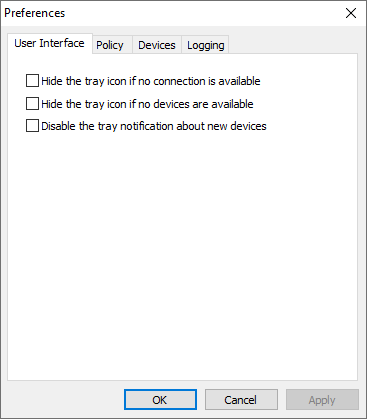
- Hide the tray icon if no connection is available
- The tray icon is displayed if the Workstation side is installed and operates normally on the local computer.
- Hide the tray icon if no devices are available
- The tray icon is displayed if at least one USB device is plugged into the local computer.
- Disable the tray notification about new devices
- Don't show tray notifications about new USB devices.
Policy settings
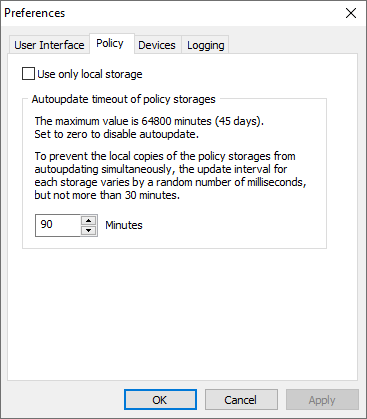
- Use only local storage
-
If enabled, the program will use local storage for both domain and local users.
If disabled, the program will use local storage for local users and domain storage for domain users
By default, this setting is disabled. - Autoupdate timeout of policy storages
- Updatе intervals of the program's device policies received from domain storage data. This setting applies only if the domain storage is used. Changes in Local storage are applied immedately after policy modification.
Devices
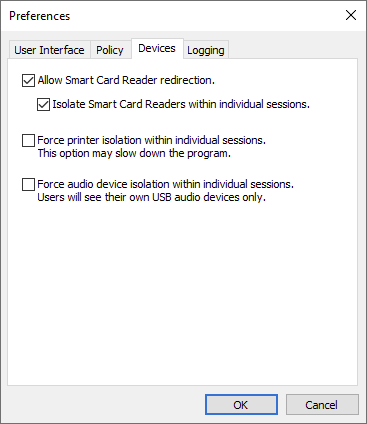
- Allow Smart Card Reader redirection
- If enabled, USB Smart Card readers will be redirected by USB for Remote Desktop.
This feature may improve compatibility with some software which use the Microsoft Smart Card API.
Smart Card redirection feature of Microsoft RDP will be disabled if this option is chosen.
This feature requires Windows 10, Windows Server 2016 and later on both sides.
- Isolate Smart Card Readers within individual sessions
- If this setting is enabled, redirected Smart Card Readers will be visible and accessible only within the owner's session and cannot be accessed by system services.
- Audio device isolation mode
-
This setting allows you to adjust the isolation behavior for audio devices, providing different levels of isolation, compatibility, and functionality depending on your environment.
- This setting is shared across multiple FabulaTech products, including USB for Remote Desktop, Sound for Remote Desktop, Webcam for Remote Desktop.
- By default, USB for Remote Desktop does not isolate redirected audio USB devices (No isolation mode).
- Important: Changes to this setting apply only to new user sessions. Users must sign out and sign in again for the new setting to take effect.
Strict
Provides the highest level of isolation. FabulaTech audio devices are fully isolated and accessible only by the user who owns them. This ensures complete audio separation and prevents cross-session access.
- Guarantees maximum isolation
- Prevents cross-session interaction
- Important: Native Remote Desktop audio redirection is not supported in this mode
- Recommended for multi-user environments requiring strict separationSession-isolated (compatible)
Provides session-based isolation with a compatibility layer. In most cases, audio devices remain isolated per session.
- Enables coexistence of FabulaTech and native Remote Desktop audio redirection
- Maintains isolation in most scenarios
- Recommended when native audio redirection must be used alongside FabulaTech
No isolation
Disables session isolation entirely. Audio devices are shared across all logged-on users.
- Recommended only for single-user environments
- If several users are logged in, all users can access the same audio devices
- May lead to conflicts in multi-user environments
Logging settings
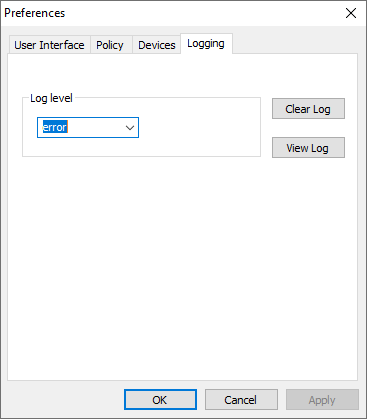
- Log level
- USB for Remote Desktop logs only errors by default. If you need to log detailed information, choose debug in the drop-down menu.
- Clear Log
- All the previously logged information will be erased.
- View Log
- The log will be opened in the notepad.